
George Grie Biography
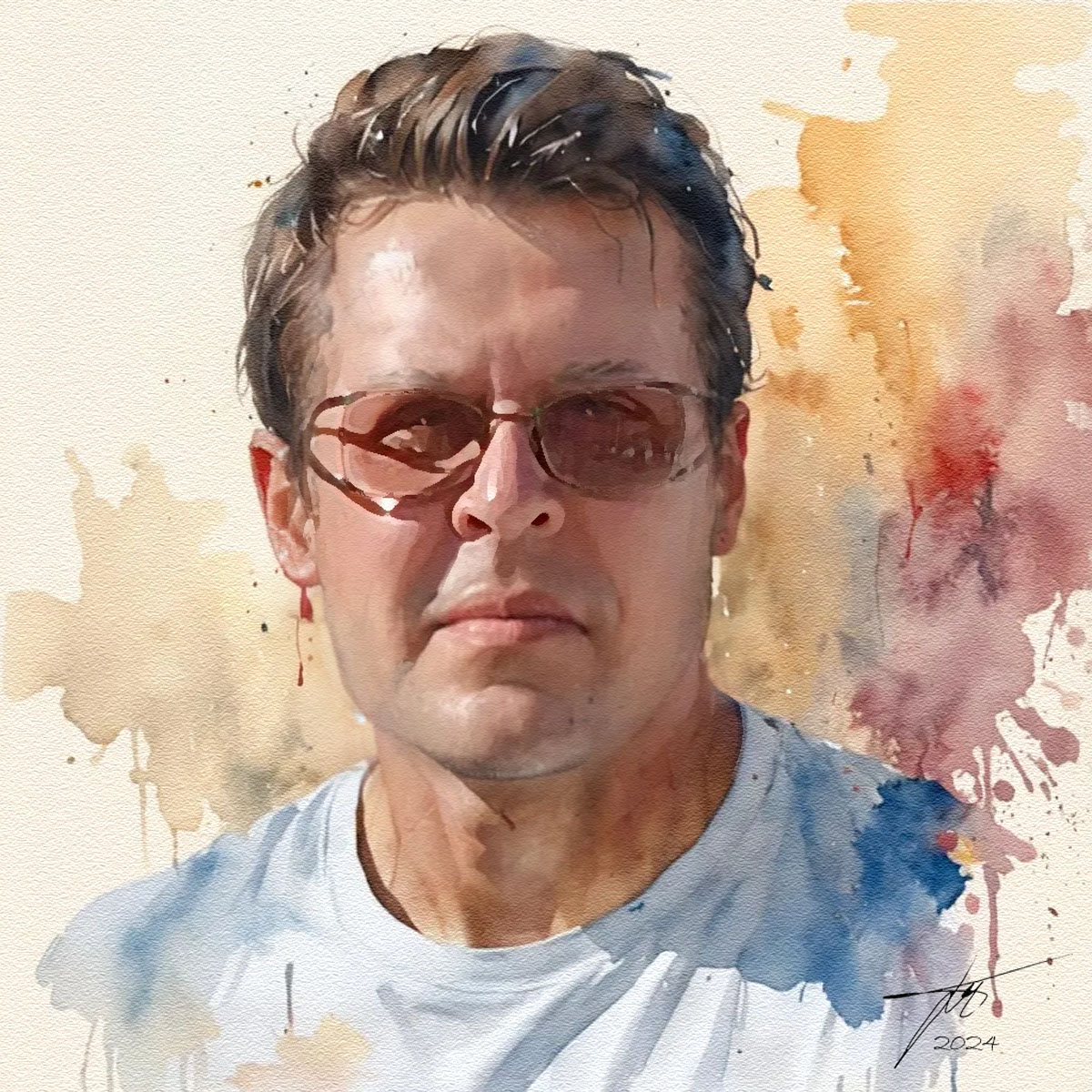
George Grie (aka Yuri Gribanovski) was born in 1962 in the USSR (Union of Soviet Socialist Republics) city of Omsk. He graduated from an Art School (1975-1979) and the State Pedagogical University (1979-1985) with a Bachelor of Arts degree in Fine Art Education. From the very onset of his professional career, it had become undeniable that the traditionally accepted and politically bound routes of the socialistic-realism art style adopted by many of his peers would never be the path to follow. Instead, he chose to explore a more complicated and demanding adventure of innovative neo-surrealistic painting wherein clear, concise yardsticks of competence, draughtsmanship, and mastery can be tangibly measured and artistically appreciated.
 |
As a result, his endeavors within a relatively short career (1985-1995) of fine-art painting have brought considerable success. He was a frequent participant of group exhibitions of the ECHO (experimental art association) and the TOWER, which functioned in Omsk during the perestroika years - from 1985 to 1989. He was friends with (Manager) Oleg Sudakov from a legendary Russian punk-rock band Civil Defense. At the beginning of 1990th, George lived and worked in St. Petersburg, Russia, where he had been an active member of the Pushkinskaya 10 (art-center). 10 Pushkinskaya Street, this address was an abandoned, rundown building on downtown Pushkin Street of St. Petersburg where independent artists, musicians, and other figures of the underground culture were squatting the house. He met many well-known later artists and musicians such as Yuri Shevchuk (DDT), Vyacheslav Butusov (Nautilus), and Sergey Kuryokhin, Boris Grebenshchikov (Aquarium), etc. George was a member of the Union of Free Artists of St. Petersburg. He had several fine-art surrealist exhibitions in some European capitals such as London, Stockholm, St-Petersburg, and Helsinki.
Grie's paintings exhibit strong and powerful images that draw their energy from a visual impact. They are about capturing visual paradoxes; sometimes, they would depict calm and contemplative moments, solitude, and melancholy. The stillness in his themes is an encouragement for introspection and self-observation. George Grie uses a photo-realistic distinction technique, which contrasts the light source and the often-dark tonality in his early paintings.
In the late 1990th, George Grie makes a life-altering decision to transform his artistic career when he settles in Toronto, Canada, and studies the latest computer techniques in Digital Media Studio. He changed, shortened his last name to a more fitting for Canada’s English-French form, and started using his middle name as a given name. He became a professional Multimedia Graphic Designer and joined the IBM Corporation (2000-2006) as a lead new media specialist. George was working there together with renowned North American illustrator Oleg Lipchenko and pioneering generative artist San Base. In early 2010th, Grie has moved to live in Florida, USA.
His prime interest now is in contemporary 3D modeling software and its applications. A phase of complete freedom of self-expression comes to play: the possibility of utilizing and combining his previous fine-art experience and classical painting education with the new digital projects becomes both realistic and fulfilling. His latest digital neo-surrealistic artworks employ a vast array of extraordinarily photo-realistic visual records of his conceptual thoughts, philosophic views, fantasies, and dreams. His popularity came from the spread of the Internet. George does not generally participate in solo or group exhibitors. His reproductions have been distributed widely by art-related websites and neo-surrealism enthusiasts. However, he considers his art rather a personal hobby than a professional occupation. Grie's works portray a magical and playful, dream-like world which invites you to a pilgrimage into your subconscious. Supernatural illusions, mystic romanticism, spiritual magic, and delusional trance are all intertwined in his virtual worlds. These worlds are far from being conventional or comfortable. There is a great deal of tension and tranquility to it, and it requires significant inner work to walk through this controversy. But it is a price you pay for taking up a journey into the landscape of imagination of this versatile and talented artist.
Grie’s artworks have been published in various magazines and books. His pictures illustrate Canadian high-school textbook Art Works, Illustrated History textbook (Denmark), French school textbook Bloggers 5ème, and University of Washington magazine. An artwork Dreamscape has been featured in Cognitive Science Journal, London University. Among others is the church of Brazil journal, Norway’s opera house, and many more.
His surreal compositions are trendy among recording artists. More than 50 vinyl and CD album covers have been exhibiting his creations. London Symphony Orchestra, Uriah Heep legend Ken Hensley & Live Fire, rock icon Jeff Cannata’s (Arc Angel). George’s imagery illustrates several projects of Magellan; the band enlists many well-known musicians, such as Ian Anderson (Jethro Tull), Joey Franco (Twisted Sister), Tony Levin (King Crimson, Peter Gabriel, and Pink Floyd) as well as Keith Howland, Lee Loughnane, Robert Lamm from the band Chicago, and many others.*
(Rus) Краткая биография Джорж Грие
photos..
*Text editor Olga Grie
Art Statement:
I’m confident that the new graphic technologies unlocked endless potentials for creative individuals. The graphic capabilities of some contemporary 3d&2d applications are far outside of common human comprehension. The sky is the limit today to exercise your imagination, intelligence, and ambitions.
Everything is possible – it has to be a motto of today and future digital artists. I’m trying to prove that in every one of my humble creations. Digital art applications give you the never-ending combinations of texture, renderings, settings of lightings, hue, saturation, and shape deformations, which bring you the sensation of full liberty and control of reality. There are no more hours of a laborious painting routine. There is no more boring drafting. Everything is instant and under the tips of your flying fingers. There is only one chilling obstacle between you and your dare creation – lack of imagination.
The new form of art - digital art was born without pompous manifestations and noisy announcements. Some of us still consider digital painting and 3-dimensional art as something mechanical and artificial, out of human touch. Nothing could be more wrong. Computers don’t make art; people do. Computers are creative tools only, the sophisticated ones. The minute you try them, you will never look back. You will never give up moving forward. It’s a new creative drug for a new generation of artists. It’s an addiction with no cure. It is a curse you can’t get rid of. It’s your blessing destiny.
George Grie, comments, Sept 20, 2003
Notes

I am writing these notes to answer your potential inquiries about sources of my artistic inspiration and some of my works' subject matters.
My new picture concepts might come from anywhere: curious window views, fantastic movie scenes, or routine commercial media visuals. The ideas are in the air. They are all over the place. Usually, future compositions come as a vague visualization of something amusingly nonstandard, something you might define as extraordinary or out of the ordinary. Typically, the first impression transforms considerably by the end of the creative process. I am surprised to see how different the results are from my original thoughts most of the time.
I am trying to merge real-world images with subconscious emotions and philosophical thoughts in most of my artworks. Many of my creations are similar to mental puzzles where you can take a trip from one point to the very end by analyzing symbolic objects. Occasionally, the subject matter of the picture is unclear. It happens when the path is hiding under layers of mutually excepted items. Sometimes, an image could appear almost abstract and meaningless, but there is always something for you to discover.
I do not force my comprehension of a picture or push my philosophical opinions about it on viewers. I only hint at them by image titles. You are free to interpret or translate my artwork content in any way close to you only. My view or even existence should not bother you. Your job is to build picture concepts based on your knowledge, world perception, preferences, and sensitivity
George Grie, September 20, 2003
Tools of trade
George Grie created digital artworks by using a variety of software tools. Here's the shortlist of the most used ones:
3D Studio MAX, Developer: AUTODESK Highly customizable and scalable 3D animation, modeling, and rendering solution for creative professionals and large-scale pipelines for games, design visualizations, film & television.
Adobe Photoshop, a graphics editor developed and published by Adobe Systems. It is the current market leader for commercial bitmap design.
Terragen, is a landscape generator with controllable parameters that allow extremely varied terrain shapes and photorealistic rendering.
Poser, Developer: Curious Labs Inc. Poser is the 3D figure design tool for artists, illustrators, and animators that enables you to create 3D figures from ready-to-use human and animal models easily.
DAZ3D, DAZ Studio - Pose, animate, and render 3D Models in your 3D Studio. Adobe Illustrator, is a vector-based drawing program
Adobe Illustrator has become the standard tool for illustration design.
